Friday, January 29, 2016

Easy Writer

Kelly Braffet, the author of “Save Yourself” and other novels, tweeted this morning about a comment to a New York Times article that described writing as "the ultimate part time job, very few hours but full time pay." I assume the commenter has never written a word outside a snarky comment board so I thought I'd put the craft of writing into perspective for the layperson:

You know how the meal you spent two hours cooking is eaten in just ten minutes? Frustrating, right? It's a lot of work for a small payoff. Well, the article you read in just ten minutes took two days to write. The book you read in just ten hours took two years to write. And those are the pieces that actually sold; most pieces are rejected over and over before they are accepted (if they ever are).

It is extremely difficult to make a living as a writer. Most working writers must work supplemental jobs in other fields to pay the bills. Writing is certainly not a part-time job for full-time pay. More realistically, it is a part-time job for no pay or a full-time job for part-time pay.

Now, please go enjoy a book this weekend. Someone wrote it because they had a story to tell, not because they wanted an easy job.

For reference, the comment was made to the January 25 article "The Improbable Rise of Mississippi Roast"

Friday, December 4, 2015

Scott Weiland Memoriam

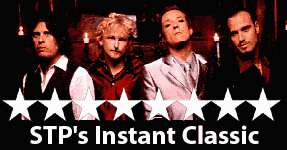
Scott Weiland, the front-man for Stone Temple Pilots and Velvet Revolver, passed away last night while on tour in Minnesota. As a memoriam, I reposted the last review I wrote about one of his recordings, STP's "No. 4," from the November 1999 edition of Renaissance Online Magazine. Because it's backdated, it doesn't show up as my most recent post, so here's the direct link: STP's Instant Classic.

Monday, February 24, 2014

Sour Grapes Make a Horrible Whine

On February 21, 2014, the Huffington Post's UK edition published an opinion piece by
Lynn Shepherd entitled "If JK Rowling Cares About Writing, She Should Stop Doing It."

This piece smells a bit like rancid click bait to me. I hope it is, for otherwise it means that Shepherd actually believes that a successful person should quit to clear the path for others.

The gist of the article is that because JK Rowling became enormously successful writing her young adult series about Harry Potter, then she should stop trying to write other types of fiction. Shepherd attempts to defend the notion that Rowling's subsequent ventures into other types of fiction aren't fair to other writers and those writers' chances of being published. In short: Rowling got her money already so now she needs to stay away so others can get theirs too.

[Read the original article here]

I'll ignore my confusion about why she focuses solely on Rowling, a legitimate writer who didn't have her success handed to her, and not on the many celebrity "authors" whose ghost-written books become best-sellers simply because the smiling face on the cover is a familiar TMZ fixture.

Even if you expand Shepherd's premise to include all known, marketable names, it still fails the sniff test and reveals a foundational jealousy and insecurity. Whether she intended to do so or not, Shepherd implies that the only reason she (and other writers at her success level) aren't populating the best-seller list is because they aren't named JK Rowling (or Snooki, or whoever).

Is that the world in which we want to live? One where you don't strive to improve and surpass your competition, but rather beg your competition to withdraw?

What a sad message to send out into the world: "You can't succeed in an endeavor because someone else is successful in the same field."

Apply that defeatist notion elsewhere and the absurdity is obvious. Perhaps each year's Cy Young Award winner should retire so as to open up a roster spot for a young pitcher in AAA who really, really (pretty please) wants to pitches in the majors.

Perhaps it's high time for Jennifer Lawrence to retire at 23-years-old so that some other kid can star in the next "Hunger Games." At the very least, Lawrence should do the gracious, accomodating thing and stick to a single genre. After all, Lawrence's success doesn't mean she possesses a unique talent that the paying public enjoys. It probably just means that she's a lucky individual among many other equally skilled and interchangeable actresses

I, for one, wouldn't want my success to rely on the voluntary departure of all competition. It will feel even better if/when I finally earn success over competitively tougher odds.

I also know for sure that competition breeds innovation. Without the heavyweights of literature, or sports, or film as goals, inspirations and aspirations, our society would be left with only middle-of-the-road performances. We would all suffer as a result. Advancements would cease if we forced a ceiling on success. It's impossible to play leap frog with nothing left to leap over.

Monday, June 3, 2013

Second-Rate First Date

First dates fall under their own special category of people-watching. Regular, run-of-the-mill people watching -- for me, at least -- involves sitting in a public place most likely procrastinating whatever task I am supposed to be accomplishing in that public place. I justify it as exercising my all-pro peripheral vision. Or as necessary physical therapy to stem the tinnitus tide brought on by years of sitting behind a drum set. Or as necessary observational foraging to gather vivid details to illuminate future writing.

In other words, I bullshit myself regularly. That trio of rationalizations -- while technically true and, I'm sure, useful in those ways -- are pure, vile, well-warmed cow manure. I people-watch because people fascinate me.

On Saturday, I sat in a public place and had the misfortune of observing an awkward first date between a man and a woman who were both around 55-years-old. One could not write a worse ad for online dating without including a crime as the night cap. Although I do think that some juries might convict this woman for the 35 minutes of subtle psychological abuse with which she assaulted this poor guy.

The couple chose chairs extremely close to me so I could hear every word of their abbreviated first encounter. Immediately -- as I was frantically searching for a way to procrastinate from my real writing -- I noticed that this man bore some form of vocal impairment. You could comprehend his words, but his tone was thick, almost like his tongue took up too much room in his mouth. I glanced over and discovered that his lower jaw thrust slightly forward and his mouth's movement seemed restricted as a result. That malformation probably explained the unusual voice.

Other than those two minor irregularities, the man seemed to be very pleasant. He sat, smiling, holding a hot coffee. Friendly. Open. The woman sat perpendicular to him without a drink. Arms folded. Closed. He tried. The poor man tried. He brought up every subject imaginable. He asked her questions about herself. She responded with cold, abrupt and disinterested phrases.

"You don't want a coffee?" he asked.

"I don't like Starbucks."

This is probably a good place to mention that they were sitting IN a Starbucks. Assuming he hadn't kidnapped her, at some point she had agreed to meet him at a Starbucks.

"What kind of coffee do you like?" This man rolled with every miserable response she gave him!

"Honey Dew," she said then shifted deliberately in her chair by tucking her chin and pushing her torso away from him. "Starbucks is too strong."

[Dating tip: When someone asks "Hey, do you want to meet for coffee at Starbucks?" and you dislike Starbucks, it is perfectly acceptable to counter with "Do you mind if we go to Honey Dew instead?"]

Next up was her divorce (still friends with her ex). Her kids (no kids). Her job (some kind of customer service job). She brought up Dunkin' Donuts just to complain that they get her order wrong so she doesn't go there anymore. She mentioned that she was born in Boston. So he asked her questions about Boston. She shut that topic down quickly: "I don't go into Boston."

He courageously followed up on her job: "Do you get a lot of rude phone calls? People complaining?"

"I know how to handle it."

What an engaging story-teller!

[Dating tip: When someone expresses interest in your job, feel free to tell a funny or interesting anecdote about that job.]

She never asked a single question about him.

[Dating tip: Among humans, when someone asks about your job, it is acceptable to then ask them about their own job. In fact, it's the most effortless way to have a conversation with another human. Simply parrot whatever they ask you.]

This went on for about a half-hour. Enthusiastic question. Grumpy, negative response. Toward the end I even took a longer look just to be ABSOLUTELY certain that she wasn't Bill Belichick in disguise.

"Have you eaten lunch?" he asked hopefully. God bless this man. How low does his self-esteem have to be that he wanted this cruel and unusual punishment to continue through an actual meal?

"I ate at home," she said, walking the thin line of condescension. One wrong step and she might smack him with her royal scepter.

By the way, their date started at noon. Let's add this to the scoresheet: she agreed to a date with this man at Starbucks at lunchtime but ate first and doesn't like Starbucks.

"Actually, I have to get going," she said then stood up. "I have errands." With that, she flipped her maroon velvet cape and strode out the door.

(In reality, she wasn't wearing a cape. However, I would bet a pretty five-dollar bill that she owns at least three.)

I wanted to give the guy some sort of "buck up, champ" punch on the shoulder. But I didn't. I hope he can bounce back and gather the strength to go on a date with someone else. And maybe he will.

I was left thinking about what it must have taken for him to put himself out there. I imagine that maybe he has extra difficulties meeting women because of his speech impediment and slight underbite. So he took a different route and tried online dating. There -- he probably hoped -- he could meet someone on even ground. A woman would get to know his personality first before superficiality could kick in. After a few emails, they finally agreed to meet in person. Then it all fell to pieces. Again.

She sucks as a person. Fine. A lot of people suck. The part I don't understand is: why agree to meet him at all? Why even join an online dating site? The very act of joining suggests that she WANTS to meet someone. She certainly didn't act that way. She acted put out. She acted like someone was infringing on her freedoms. She acted like the founder of the ACLU being dropped into a nationally televised TSA cavity search.

Even if she were so superficial that two minor flaws in a 55-year-old man were insuperable, at least be nice and have normal human interactions. Don't act offended. You agreed to this date! I haven't checked the dating rule book in quite some time, but if memory serves, you aren't obligated to have sex with a guy just because you were nice to him. Make the most of the 35 minutes. It's small talk. There is no imposition in a voluntary situation.

Her bizarre entitlement and/or core unpleasantness spoke volumes about her. This is why you're single, lady. You think you're better than other people. Not everyone is compatible but that doesn't make you BETTER than the other person.

I should have told this guy that he deserved better. Or at least tripped the miserable lady who had probably ruined his beautiful Saturday.

Saturday, April 6, 2013

Coffee Talk

I spend a lot of time in coffee shops, most often Starbucks but I don't believe in exclusivity so I make sure to spread the love to other, smaller, establishments as well. Before meeting my girlfriend four years ago, I rarely drank coffee  -- and had never drank a drop of iced coffee. Her obsession with coffee runs deep. Very deep. Think Bubs from "The Wire" and you'll be in the right neighborhood. I enjoyed spending time with her so, in the beginning, I became sort of like that kid, Johnny Weeks, who followed Bubs around and helped him collect copper wire.

(To be clear, no copper wire has been stolen to pay the Seattle cartel for their product.)

Tools of the Trade: an Iced Trenta
compared to a horizontal iPad.
I now fear that, much like Johnny before me, I'm more of an addict than my mentor. For example, in the last three hours at Starbucks I have consumed a Trenta iced coffee (31 ounces) and a Venti iced coffee (24 ounces) and she is still only three-quarters of the way through her first Venti. You could say that I am running laps around her. Seriously, you could literally say that. After 55 ounces of black gold, I sprint everywhere, both physically and mentally. I'm not sure what the average hummingbird's heart rate is, but I may have that average hummingbird beat right now. In fact, it feels like I have a flock of hummingbird's happily flitting through my veins.

So, yeah, I may have a problem. Before the calorie police invade my house, shouting through their ubiquitous bullhorns "DO YOU KNOW HOW MANY CALORIES ARE IN 55 OUNCES OF STARBUCKS COFFEE?" allow me a preemptive strike: my coffee is black and almost completely free of any sweeteners. That's right, I drink my coffee straight like a damn cowboy on a week-long cattle drive. If cowboys sit in franchised drug dens, typing on bluetooth iPad keyboards, while the accompanying soft jazz blandly attempts to soothe a plague of overactive hummingbirds.

While we are on the topic of the Trenta, please indulge a tangent. I think the Trenta is the greatest invention in the history of the human species. You can keep the wheel because Trenta makes me levitate. You can keep electricity because that is a discovery not an invention, and, besides, the Trenta lights me up very efficiently all on its own. Keep it all. I'm on a Trenta-fueled vision quest and you won't convince me otherwise. (Even if you could, I wouldn't notice because my mind is wandering and adventuring like Lewis and Clark with rockets strapped to their backs.) Despite its amazing contribution to our species (assuming only humans are reading this), it does bother my obsessive psychology that Starbucks named it "Trenta" because that is the Italian word for "thirty." To be fair: the word fits in well enough with their existing Grande and Venti names. Many companies use foreign words to sound hipper and more exotic. But for God's sake, use the words correctly! As I mentioned previously, a Trenta is 31 ounces not 30. Yes, Trenta sounds better than "Trentuno" but why not make it a 30-ounce cup? Was there a sale on 31-ounce plastic cups the day the Starbucks' Size Squad came up with this idea?

On second thought, never mind! If you work for Starbucks corporate, please stop reading. Ideally, forget what you just read! I don't want to sacrifice even a single ounce. Trenta is a fine name. I swear! I'll just choose to see it like an Italian woman who just turned 31 but still tells everyone she's 30 because that somehow sounds better. (I guess, in reality, that vain birthday girl would probably be using the word "ventinove" -- or 29 -- and not "Trenta" but there's no reason to further complicate my indoctrination.)

However, now that I think about it, they didn't correctly translate the 24-ounce Venti (Italian for 20) either. In an increasingly unpredictable world, at least they're consistent. Let's chalk it up to Starbucks not being an Italian company and move on. I'm here for the coffee not the linguistics lesson anyway.

Looking back, I suppose I should just admit that I took you on more of a bumpy detour than a quick tangent and merge back into the topic at hand: being high at Starbucks while my girlfriend knits yoga leg-warmers across from me and thinks I'm working on my novel.

I started on my road to addiction as an embracing of something a pretty girl enjoyed. Shamefully, we were Dunkin' Donuts people then. I had never really liked hot coffee except late night at a greasy spoon diner while drunkenly plowing through chipped plates of runny eggs, undercooked bacon, and toast that wore slabs of butter like Paula Dean's most erotic dream. That sludge, enhanced with a ton of sugar and creamer, became my baseline for coffee. I make no apologies for it. We all make bad decisions when drunk.

Soon a light shone from the Heavens in the form of Iced Coffee (revered proper noun). Double brewed and strong! Unlike my experiences with hot coffee which seemed to have a six-second window when it was neither too hot nor too cold to drink, this Iced Coffee had every window and door wide open. All the time! I dove through that open window with acrobatic exuberance and my baseline quickly shifted toward bold attempts to mainline my new discovery.

(This idea of "too cold" hot coffee is one of the great ironies in a society that also passionately consumes iced coffee. Is there anyone who would refuse to eat cooked fish after it has gotten cold but later happily and greedily eat chunks of fish intentionally served cold? Wait. Shit. I just described sushi.)

From Dunkin' Donuts, we gradually evolved to Starbucks. Settle down everyone who runs on Dunkin', I used "evolved" to bait you. I didn't intend it to be an insult. I meant it in the way that suggests you still have a tail and I don't. Tails are cute, not grotesque. I promise.

From Starbucks, there was -- and still is -- no turning back. Even if it were possible to turn back, I wouldn't want to. Like I tweeted one day, I now think Dunkin' Donuts is to methadone as Starbucks is to heroin. Would Bubs and Johnny scavenge copper wire for methadone if they could score some heroin? I think not.

Eventually and inevitably, I turned various Starbucks locations into my office. Since the beginning of November 2012, I have been attempting to write my first novel. I have written every word in either a Starbucks or some mom-and-pop coffee shop. I average around 750 words per hour which quite conveniently coincides to one Trenta. See? Karma. I have also written every single word on an iPad with a bluetooth keyboard. This has been an interesting experiment, one that just three short years ago would not have been technologically possible. I know that when I sit down at Starbucks with my iPad, then it's officially time to work.

I imagine that this is exactly what life coaches mean when they advise people to find what they love and then figure out how to make that their life's work. For me, Coffee, Starbucks, and the Trenta started as excuses to spend time with a girl then moved on to a delightful chemical addiction. Now I have a familiar and comfortable environment that helps me overcome my previous mental block and procrastination over what can be a very daunting writing goal.

If I ever finish the book, I hope every reader enjoys it while curled up with a cup of their favorite variety of coffee. Or, at least, uses it as a coaster beneath their favorite variety of coffee.

Tuesday, January 29, 2013

Dental Damning

This afternoon I was rejected from donating blood because I had a simple, basic dental cleaning this morning. The guy with smoker's cough and yellow teeth, who was filling out his form across from me, was accepted.

This makes me wonder which of us the future blood recipient would choose? Assuming a hypothetical scenario in which that patient has access to either a menu of potential donors with their picture and vital statistics or, at the very least, a buffet where we all line up like dishes of tantalizing Chinese food during the lunch rush.

Maybe I'm crazy or simply not an educated part of the health care elite, but, after perusing all the options at that buffet, I would choose the person who looks the healthiest. The person who appears to take care of himself and, by extension, his blood (which will soon be hanging out with my blood). I would not choose the person who just coughed up a half-ounce of tobacco residue all over the crab rangoon like he was the worst Iron Chef contestant ever.

Now, I have donated blood many times in the past and have never before seen a question about recent dental care on the form. If you haven't ever donated blood, I can assure you that it's very easy to figure out the purposes of all the other questions on the donor history form. Because of that, I assumed when I checked "yes" that the technician would ask me what kind of dental care I received. I would answer "basic, routine cleaning." She would then ask if they administered Novocaine or any other injection. I would answer "no" and we would gleefully high-five at the prospect that soon a healthy pint of my blood would be milked out of me and on its way to a sick kid.

I'll call this sick kid, Ralph. I don't actually know the name of the kid who would have received my blood because of patient confidentiality or some such thing, but you don't see the name Ralph around much any more and I'd like to kick-start a naming movement. Aside from being sick, Ralph is a normal kid. His mother probably even has to beg, plead and bribe to get him to brush his teeth each night. In a few years, if he survives his transfusion of nicotine-enhanced blood, Ralph will stumble across the word "irony" and the circle will be complete.

However, that is not the way the scenario played out. Instead, she paused at the checked "yes" and asked what dental care I had received and when it had been. I confidently answered "basic, routine cleaning this morning at 8:00." She responded quickly: "You aren't eligible to donate blood today. You can't donate until Thursday morning." What? No high-five? Just an abrupt kick to the curb.

Since I had never heard of this policy before, I asked why. Her explanation was that a dental cleaning can create small openings along the gums that then have increased susceptibility to bacteria and infection. I wanted to point out that a splinter in my finger would create the same risk and there was no question (and therefore no concern) about recent splinter wounds. I wanted to laugh and ask if my mouth would be at less of a risk if I had munched on a small morsel of cow manure and not cleaned my teeth. But I didn't say anything. The implication was clear: a human mouth is dirtiest immediately after being professionally cleaned. I was simply thankfully that the same wasn't true of a restaurant's cutlery or a surgeon's hands.

One would think that dental hygiene would be viewed as a positive. In fact, I seem to remember at least one cartoon toothbrush and his companion talking toothpaste telling me that it was one of the best things I could do for myself. "Healthy teeth, healthy me" or some similar bullshit propaganda clearly distributed by the powerful anti-blood-donation and anti-sick-kid coalitions.

(While on the topic of a cartoon tube of toothpaste squirting the contents of himself on the bristled head of his toothbrush pal, one has to wonder if anyone has researched the lasting psychological effects the anthropomorphizing of everything is having on the kids who watch these things. I, for one, would not hang out with someone or something who winks at me casually before intentionally spilling the contents of his body all over me. I certainly wouldn't wink back and then, with a big smile, leap into a monstrous mouth and go all Gangnam Style on the teeth inside.)

Everything we have been told about dental care, by humans and cartoon health and beauty aids alike, has been a massive lie. Tooth and gum care is a dangerous, condemned activity. In the world of trying to do something nice for sick or injured people who need a blood transfusion to stay alive, my lack of plaque falls somewhere between sharing a needle with a Taiwanese sex slave and maximum security incarceration in a nudist prison colony.

This is, of course, followed by noticeably exiting without donating. They might as well have attached a scarlet "Y" to my shirt just to further drive home the point that I had checked "Yes" to one of the questions. Among a list of questions asking about AIDS, drug-use, prison-time, prostitution, STDs, shared needles, unprotected/careless sexual activities, and experimental medications, I dared to answer "yes" to the question "Under the past 24 hours have you been under the care of a dentist." For shame, Flosser! Damn you, Brusher!

I'm just thankful that it was a "confidential" form. God forbid that anyone had found out that I went to the dentist as opposed to any of the other possibilities. I would be shunned from normal society for years and forced to live in an isolated freak colony with others of my kind. A habitat whispered about in the dark to the young as a warning. A place devoid of halitosis and cavities. A shameful place.

Walking off a mobile blood lab after everyone knows you have been rejected for something is a special kind of humiliation. You walk on, sit down, fill out a form, go into a closet to be interviewed, then walk past all of the donation couches and exit the lab. Everyone present knows what those forms ask and what is confirmed in the interview. And not a single one of them was thinking "must be his clean teeth" when negatively judging me during my walk of shame.

Thursday, October 18, 2012

Relationship Change

A romantic relationship should be called a Plural. (Two singles getting together.)

Q: “Are you single?”
A: “No, I’m plural.”

Facebook relationship status: Plural.
Cheesy Cameron Crowe dialogue: “You pluralize me.”
Break-up: “We singularized. Ice cream, please.”

Tuesday, July 10, 2012

Locura

Voices in my head rumble like Estadio Azteca.
Tirelessly. Yo no hablo español.
Violate my sleep all night with radio mariachi.
Tired, I agree: so now soccer is fútbol.

Wednesday, July 4, 2012

Independence Day Flashback

My favorite Independence Day (aside from 1776) was 15 years ago when I was visting my brother and sister-in-law on a U.S. Air Force base in England. It was both surreal and awesome watching members of the U.S. military celebrate their independence from the same country where they were now stationed as allies.

Thursday, May 17, 2012

In the Wink of an Eye

My maternal grandfather, Raymond Washburn, died peacefully at 3:00 this morning at the Philip Hulitar hospice center in Providence, RI. He would have reached his 92nd birthday in two weeks, on the Tuesday after Memorial Day weekend. We moved him by ambulance to the hospice center around noon this past Sunday - adding an anxious solemnity to Mother's Day for his daughters and wife. It had become clear after a difficult Saturday night that he didn't have much time left. By Wednesday, he was no longer opening his eyes and was unaware of his surroundings, his visiting family, or the staff. It had been a difficult 18 months or so for that side of my family as he started this slide into dementia shortly after his 90th birthday. He had been on oxygen since June 2003 and had stoically dealt with other physical ailments, as the elderly so often do, including a quadruple bypass. He was a fighter. His mind had always been his strength and suddenly even that was failing him. By his 91st birthday, at our traditional annual cookout to celebrate three generations of birthdays all occurring on that one holiday weekend, I had to re-introduce myself to him.

My Granddad was a quiet, dignified man who was always extremely sharp, with a bright wit, and a constant mischievous twinkle in his eye. He could convey more with a subtle wink than most people could say in a verbose soliloquy. He was hungry reader, consuming large quantities of books, including favorites written by Robert B. Parker and James Patterson. He nourished a large appetite for watching sports as well. It basically didn't matter the game; he enjoyed almost all of them in a regular buffet of televised athletics.

Some of my favorite memories of him were discussing the Boston Red Sox or the New England Patriots. Over my own life as a Patriots fan, he took me to my first training camp at Bryant University and I was able to return the favor years later when I had season tickets by taking him to a game at the old Foxboro Stadium. In 1985, I cried confused tears in his living room when my scrappy team of heroic Davids failed horribly in the Super Bowl against an historic Goliath from Chicago. On New Year's Day 1995, our family gathered at the Layfette House in Foxboro for my grandparents' 50th wedding anniversary. A number of us, including my grandfather, spent large chunks of the party sneaking off to the bar area where we watched a Bill Belichick led Cleveland Brown's team knock the Pats out of the playoffs 20-13. For awhile, throughout high school and college, my Christmas gift to him each year was tickets to a Providence Bruins game with me, my Dad and sometimes my Uncle Joel. Hockey was one sport he didn't watch on TV, but still loved going to the games nonetheless.

He carried his love of sports into his own participation in bowling leagues well into his late 80s. When he was forced to stop bowling a few years ago, after falling and injuring himself. I was similarly forced to confront the idea of my grandfather's fragility for probably the first time. He was disappointed to lose his time and camaraderie at the bowling alley but tried to remain active at home, in their large yard, almost until the end (against the advice and wishes of his wife and children!). As recently as last Saturday, unbeknownst to my grandmother, he got dressed in their upstairs bedroom, shuffled downstairs, and was settled in his chair, following the routine he had for years. I can't say for sure, but I suspect that even on that day before he moved to hospice, he still found the time and energy to sneak a tasty morsel of something to his cat and constant companion, Tiger.


My grandfather's 90th birthday celebration in 2010 at Eggs-Up in Cumberland, RI, his favorite (and regular) breakfast spot. I always got a kick out of the amused expressions on his face when my grandmother was telling a story. She is infinitely more loquacious than he was.

He left behind an impressive legacy: a 67-year marriage, six children, 14 grandchildren and 11 great-children (with a twelfth on the way). His children created their own lives and their own families from West Virginia to upstate New York. To this day, the smell of pipe tobacco immediately conjures an image of him snapping a match then taking a satisfied first puff. Whenever I see a car with dealer's plates, I remember visiting him at work at Pierce Chevrolet in downtown Pawtucket. In fact, I purchased my first car from Mandeville Chevrolet in North Attleboro, where he was then lending a hand with their accounting after his "official" retirement.

I was fortunate enough to be able to spend time alone with him early Sunday afternoon. I turned the Red Sox game on and thankfully it was one of the few games this season in which they played well. Despite being quite confused about that day's change of scenery, the anxiety of the ambulance ride, and buried within the cruel fog that had clouded his mind for so many months, he still seemed aware that it was a Red Sox game. He raised his eyebrows and seemed surprised when I told him that they were playing poorly this year. It's probably a tiny blessing in disguise that he was able to maintain much fonder memories of his favorite baseball team than the rest of New England has right now. For a moment, after the nurse pricked his arm with a needle, he was himself again. Charismatic, charming and harmlessly flirtatious. He smiled widely and introduced himself to her, "I'm Raymond!" Turns out, that was the last time he ever spoke. I swear he even tried to wink.

--30--
Raymond Washburn 1920-2012. While maintaining a quiet patience, unfailing dignity and a robust mind, he always met the world with a twinkle in his eye.

Friday, October 21, 2011

Faded Picture

Three oaks lined the driveway, sprouting icicles like daggers. A tiny fir stood in the yard, bent low by the weight of the storm. A sheet of ice lay, hidden, beneath the snow. Ricky Ortolano lifted a shovel full of heavy snow and remembered just how dangerous it could be.

They call it black ice when it hides out of sight. When it blends in perfectly -- waiting. They should call it what it really is, what is easily forgotten: nature's booby trap. Pristine prettiness, a winter wonderland.

Slipping in a winter wonderland.

He had the habit of reworking song lyrics to fit his needs. That one fit. Not that he wanted it to, but he couldn't change the past. Turning back time remained the futile hobby of fools and dreamers. Ricky saw himself as neither. Yet the past always lurked, rearing its sometimes ugly head when he wanted to forget.

Ricky smelled hot chocolate and coffee, and felt the warmth of a space heater drive the cold away. He saw the old man with an ugly purple bruise surrounding his left eye. Saw his Gramps as he used to be and remembered.

"Looks like you're going to have a shiner for a while Dad," his father had said. "What happened?"

"Slipped on some ice shoveling this morning."

"Smacked it hard too," said his grandmother, entering the room from the kitchen. "We put some ice on it so it wouldn't close up. Joe's son came over and finished up the driveway."

"It could have been worse, Dad. You'll just look like you fought Muhammad Ali for a while."

"Just tell everyone that the other guy looks worse," Ricky said.

They sat on the sunny, enclosed porch that Sunday almost ten years ago and ate fruit pastries as usual. His father and grandfather discussed seed catalogues and Red Sox spring training. Ricky ignored them all, lost in the comic pages.

Now as he shoveled his own driveway he saw his grandfather as a different man. His injury had turned out to be much worse than just a black-eye. Gramps had begun to complain of headaches and dizziness several weeks after his fall. Doctors diagnosed the blood clot on his brain and scheduled immediate surgery. There was no usual anymore, only the unexpected.

Slipping in a winter wonderland, indeed.

"We'll be back in a few hours, honey," Ricky's mother had said. "Don't stay up too late."

With this, his parents had left for the hospital. He had been too young to go, instead he had stayed home with precious memories of Vincenzo Ortolano. Too young to go to see Gramps the night of the surgery, but still old enough to worry.

"You threw that one just like Nolan Ryan," shouted Gramps, dressed in his customary tough cotton work pants and a white t-shirt. He always had time to show them how to hit with the ancient wooden bat from the garage. Always made time to put on the split, worn catcher's glove with its dangling rawhide laces and catch their fastballs. The baseball bat and glove shared the garage with assorted gardening tools and a blue Chevy topped by a cracked vinyl roof. The car looked run-down but ran fine, carrying them to the Cape in the summer and the mountains in the fall. The upholstery had holes and cloth hung like a canopy from the roof but Gramps and the Chevy always took them where they needed to go. The winter before the surgery, the car quit. Gramps said the cold finally killed its engine.

Blueberry bushes lined the back fence of his grandparents' huge yard and one resilient apple tree stood crooked in the center. It always seemed that these blueberries and apples made the best pies. Pies with light crusts and fruit oozing when you cut them. Ricky could mark the seasons by the fruit. He sat on the big handmade wooden swing in the summer while his parent picked the blueberries, and Gramps worked, whistling out-of-tune, in the garden. In the fall he gathered fallen apples from the ground and put them in brown paper shopping bags while his father picked others from the branches.

His whole life that white house had functioned as the meeting place for any family gathering. Countless holidays, birthdays and Super Bowls were all celebrated under that roof. How many of these traditions would change?

"Don't use the sticks when you go down there, okay boys?" Gramps would always say.

The younger grandkids had only been allowed to use the pool table if they used their hands instead of cue sticks. It made for strange games of pool, but saved the delicate felt from ripping under spear-like shots. The table filled the middle of the basement, too close to the walls on two sides. On these sides cut-down sticks had to be used, changing the shape of the game but not for the worse. The closets in the downstairs spare bedroom made excellent hide-and-seek hiding spots.

"Come on!" a voice would occasionally yell from upstairs. "Reagan's policies are horrible."

Ricky knew they weren't really angry. The adults would argue over their wine and enjoy every minute of it. "Mix it up," as Gramps liked to say.

Gramps didn't die that night in surgery, but a member of the family did. An allergic reaction to the anesthetic resulted in a coma, which lasted several days. He finally awoke as just a shell of the man they had all known. He gained consciousness as a familiar stranger to them while they darted as blurry shapes on the outskirts of his confused memory. Ricky couldn't imagine anything more horrible than introducing himself to someone who had watched him grow up. He couldn't begin to understand how much more difficult it must have been for Gramps. Once, a strong independent man, Gramps suddenly needed help doing everything from walking to eating to remembering people's names. The family lovingly took turns walking with him along the corridor as rehabilitation for his stiff limbs. Simple prayer and patient reminding treated his mind.

They watched him clench his hands, striving unsuccessfully to make a fist. Those same hands had once propped up broken tomato plants and had picked tiny blueberries from their bushes. The hardest part for Ricky was watching Gramps struggle to eat, something he had loved to do. "Mangia," he would say as he passed the bread basket. "It'll put hair on your chest." After the surgery, Gramps fought to just hold a fork. He held everything clumsily in his left hand because his right no longer gripped with any strength.

"Try reading this line, Gramps," Kate said, pointing with her finger and Ricky remembered when these roles had been reversed. Gramps and Kate had always enjoyed riding together to the library, where she developed a great love for books. One entire wall of his house had been covered with Reader's Digest abridged books. Now he stumbled over children's stories.

The memories troubled Ricky. He kicked a chunk of snow in frustration and cursed himself for being selfish. Gramps hadn't died and that was good. There was no reason to turn back the clock; he still had his grandfather.

When the last section of driveway was clear, he drove the few miles to the brick apartment building his grandparents now called home.

His grandmother sat in the kitchen with her back on a pillow, cursing the checkbook. "He always did this," she said nodding down the hall. "After all these years I still can't get the hang of it."

Gramps sat, slumped in an over stuffed chair in the den, watching television. The light from the set reflected brightly in his glasses. He looked up when Ricky entered the room.

"Hi Gramps, how are you?"

"Good...how...are you?" came the reply, slow and calculated. Gramps needed time to phrase his sentences. Ricky could tell that he knew what he wanted to say but the words didn't flow quickly anymore.

"Not bad," Ricky said. "It's a nice day, why are you in here?"

"There are good stories on today," Gramps answered and turned back to the television. As Ricky walked over to watch with him, he noticed a framed picture on the end table. It showed a yellowing bride, groom and wedding party, smiling at the camera. He had never noticed the old photograph before.

"Is this you and Gram?" he asked.

"Yes," Gramps said without looking up.

The picture had faded a lot with some spots completely bleached out. The pictures on the table next to it were all crisp and new. Ricky wasn't sure that made them any better. As faded as the wedding picture was, he could still make everyone out. Faded, sure, but still there.

--30--

Author's note: I originally wrote this short story in 1992 for a short fiction class at Fairfield University. The inspiration for the story then was my paternal grandfather, Leno "Pancho" Ridolfi, who passed away this week on Wednesday, October 19, 2011. My Grampa was survived by his wife Lillian, three sons, a daughter, ten grandchildren, and eight great-grandchildren. Personally, from a very young age, I learned about kindness and hard-work from him. His public obituary on Thursday morning summarized his life: family, baseball, work, his garden and his faith. He put everything he had into those things. Consistent, passionate and thorough in all that he did. He will be missed deeply, but no doubt remain reflected in the family he left behind.

Thursday, December 3, 2009

Shootout Abilities Could Determine Bruins' Season Fate

Boston Bruins' games are turning into glorified skills competitions rather than hockey games. Forget about team defense and a deep roster - too often this season Boston's fortunes have swung on the ability of a single, lonely player to deke an opposing goalie. Mano a mano hockey if you will.

Heading into Wednesday's game against Tampa Bay, the Bruins had three straight games decided by shootout, bringing their season total to nine. Already. In only 26 games. That's over a third of Boston's games (by far a league high) being decided by a few individual players rather than the full team. To put that into perspective, last season the Rangers led the league in shootout appearances with 16 over a full season (19.5%).

As a result, the Black-and-Gold could have their highly anticipated 2009-10 season decided by their success in the shootout. Given the team's questionable one-on-one scoring abilities this doesn't bode well for the emotional health and frayed fingernails of the Causeway Street faithful.

That may, at first glance, seem like unnecessary worry since the team won two of their last three shootouts and five total on the season. However, don't let the high win total fool you - that also means they have lost four shootouts (fourth highest in the league). With a pedestrian 5-4 record in Bettman's Breakaway Bonanza, the Bruins are giving valuable points away in a tight conference if they don't win in regulation or overtime.

Didn't Bruins fans have higher hopes than that for a team that finished with the top seed in the East a year ago?

The teams ahead of Boston in the Eastern Conference standings - Pittsburgh, Washington, New Jersey and Buffalo - are a combined 13-3 (81.25%) in games decided by the shootout. The comparison is night-and-day. If the Bruins want to be considered an elite team they need to improve their success rate drastically. Particularly if so many of their games are going to be decided that way.

Their stellar goalie tandem of Tim Thomas (last year's Vezina winner in case anyone has forgotten) and Tuukka Rask both excel when facing just a single skater. Their combined 75.9% save percentage is much better than the league average of 69.03%. Thomas alone is stopping an eye-popping 84.6% of his chances. The shootout wins the team does have are almost solely because of that goaltending.

With such reliable goaltending, the Bruins should be coming away with wins more often than just half the time. Therefore marked improvement needs to come from the shooters.

The skaters that coach Claude Julien sends out are simply not holding up their end of the bargain. Boston is currently a mediocre 16th in the league in shooting percentage. Given that shootouts are usually decided by a one-goal differential, imagine how many more wins they would have with better production from their shooters.

This isn't a new problem under Julien. The last two seasons they ranked 26th and 28th in shooting percentage in the shootout. Sadly, their current below-average season relative to the rest of the league is actually a step in the right direction for them. It just isn't a big enough step.

Last season, they could get away with a poor showing in shootouts because they very rarely were in that position. They won their games long before the clock ticked to zero. Only ten of their games were decided after overtime. This season they could match that number with two-thirds of the season still remaining. With an anemic, inconsistent overall offense resulting in so many close games, it is more important than ever for Julien and the shooters to get their acts together.

Julien often falls into the coaching mistake of choosing his more veteran players for his shootout lineup. Doing so defies logic. During the course of a traditional game it makes sense to use your veteran players in big moments. They've been there before and you trust them not to make catastrophic mistakes like taking a stupid penalty, failing to get back on defense or turning the puck over. In the shootout all of that goes out the window. The only negative result for a skater in the shootout is not scoring. That's it.

Having experience in the team game does not necessarily make you a better, more experienced one-on-one performer.

The two glaring examples of Julien's over-reliance on his veterans was his continued use of P.J. Axelsson last season and his perplexing use of Mark Recchi against the Canadiens in early November of this season.

Axelsson did a lot as long-time Bruin and earned a gritty place in every fan's heart. What he never did was demonstrate scintillating one-on-one skills. Julien threw him out there to try his hand at the shootout in November 2008 against the Chicago Blackhawks and, miracle of all miracles, P.J. scored using a move that had no chance of working again. Julien, thinking he had caught scoring lightening in a Swedish bottle, kept sending P.J. out there after that. Time after time he was denied.

Recchi, at 41-years-old, had only participated in ten shootouts in his career prior to this season. He ranks as the fourth worst in the NHL with a career shooting percentage of an abysmal 9%. Even Pauly Shore's movies didn't bomb that badly. Throughout his long career, Recchi has made his living in front of the net chipping in rebounds and creating traffic. Those skills do not translate in the shootout. Yet, for some reason, Julien pointed a finger at his veteran and asked him to decide the Canadiens' game for his entire team. How did Recchi repay his coach for this trust? He skated directly into Montreal goalie Carey Price and didn't even get a shot off. What do you expect from a guy who has been taught to create traffic in front, I guess. Too bad it look more like a car wreck.

This season, Marc Savard is the only Boston player to crack the league's top 60 in shooting percentage (on just two attempts due to his injury). Patrice Bergeron is their next best option having scored three goals on nine attempts. However even those two don't garner a lot of confidence. In fact, the Bruins veterans can all pretty much be found populating the list of worse active career shootout performers. Recchi, Savard, Michael Ryder, David Krejci, Marco Sturm and Bergeron all rank among the top 60 inept players for those with a minimum of ten shootout chances.

Does that list look familiar? It should since - along with Blake Wheeler (who has had an off-year after flourishing in the shootout as a rookie) - that makes up the list of players to whom Julien turns first. He must have better options than that. We all know Phil Kessel is gone, taking his 11 career shootout goals (36.67%) with him. Despite that departure Julien could very well find answers on his own bench.

Players like Vladimir Sobotka, Brad Marchand, Mikko Lehtonen, and even defensemen Matt Hunwick and Johnny Boychuk all enjoyed shootout success for the Providence Bruins of the AHL. Wednesday night, both Marchand and Lehtonen scored in the shootout for Providence, earning a win against Bridgeport. All of them have spent time on the Boston roster this season. Why not give them an opportunity to win a game for Boston too? They can't be any worse.

The AHL has not only used the shootout format longer than the NHL but its rules call for the use of five shooters per round compared to the NHL's three. Additionally, unlike the NHL, those are the only five skaters used, making it possible for a player to shoot more than once in the same game. (Next season the AHL will adopt a change to their format similar to that of the NHL in which no player can shoot twice until all eligible players have shot.) Those two current rule differences between the AHL and the NHL means the players who have played at that level of the minors have significantly more experience shooting one-on-one. Give these younger guys a chance.

Additionally, I would suspect that the younger guys on the roster are more likely to stay on the ice following the end of practice trying trick shots and competing to outdo each other. How can that extra practice not be rewarded with success when it counts? Remember - the number of NHL minutes played isn't going to help in this specialized situation. The only things that really matters is your ability to play one-on-one and your individual creativity with the puck. It's about the ability to play as an individual. The last guy on your bench could be better at those things than your team captain even though you might not otherwise trust him with team responsibilities like killing penalties.

None of this even takes into account the Bruins' offseason decision to let center Martin St. Pierre leave for the Ottawa Senators. Not only could they have used the 26-year-old when Savard broke his foot in October, but St. Pierre is a master of the shootout. For Providence last season it was a rare to see St. Pierre stopped in their many shootouts. In fact, March 20 against Albany was the one time I remember him getting denied and that was on his second chance after already scoring on his first. It really says something about talent when the fans are noticeably shocked when a player doesn't score. Apparently Rask, who was in goal that night, was shocked as well since he made YouTube history a few seconds later by maniacally flinging a milk crate onto the ice after the loss.

The Bruins' shootout streak had a good chance to extend to four games last night since the Lightning are currently fourth in the league with 24% of their games decided in that fashion. They are on pace for 27 shootouts for the season. Given that pace, shouldn't Julien be doing everything in his power to give his team its best chance to pick up a win?

Aside from what you may think of the polarizing issue of the shootout being a part of hockey, it appears to be here to stay. The Bruins need to accept that it isn't going anywhere and prepare for that aspect of the game just as they would any other. Traditionalists might not accept it as "real hockey" but it could have a very real impact on Boston's chances for success this season.

###

Monday, November 1, 1999

STP's Instant Classic

Update: December 4, 2015: Scott Weiland, the front-man for Stone Temple Pilots and Velvet Revolver, passed away last night while on tour in Minnesota. The following is the last review I wrote about one of his recordings.

Originally published in the November 1999 edition of Renaissance Online Magazine. Reprinted by permission.

Stone Temple Pilots carry rock on their shoulders

Stone Temple Pilots
STONE TEMPLE PILOTS
No. 4
(Atlantic)
11 Tracks
Running time: 42:17
Rating: A
Rock music should punch you in the gut, wake you up and all the while give you something substantial to chew on. Style-shifting masters, Stone Temple Pilots, manages to do just this on their eagerly awaited fourth release, simply titled "No. 4".

In the three years since their last album, "Tiny Music...", the quartet has experimented with new sounds - and in singer Scott Weiland's case a renewed sense of rock star immortality. While the rest of the band took a bad detour with their Weiland-less side project Talk Show (1997), they have seemingly realized that the key to their success lays in the unreliable hands of their troubled singer.

Weiland has been in and out of prison and rehabilitation centers, but when his band mates can get him to focus on music the results are amazing as evidenced by "Sour Girl" and "I Got You", two tracks that showcase both the band's diversity and Weiland's melodic gift.

In large part, "No. 4" manages to avoid falling into a niche - something that, contrary to popular belief, is the most tell-tale trait of STP. They had been labeled Pearl Jam clones on their first album "Core" (1992) before moving onto the more melodic Beatles-influenced "Purple" (1994). They switched gears again with "Tiny Music" and continue the pattern on "No. 4". STP, is simply put, the most creative force in rock today, relying on the merits of their songs rather than hiding behind smoke and mirrors like so many of their contemporaries.

Want proof that rock is on it's way back? Lend an ear to Stone Temple Pilots burning through "Down", "No Way Out" and "Heaven & Hot Rods". As for hope for the future: STP keeps improving with age.